


Cart
0

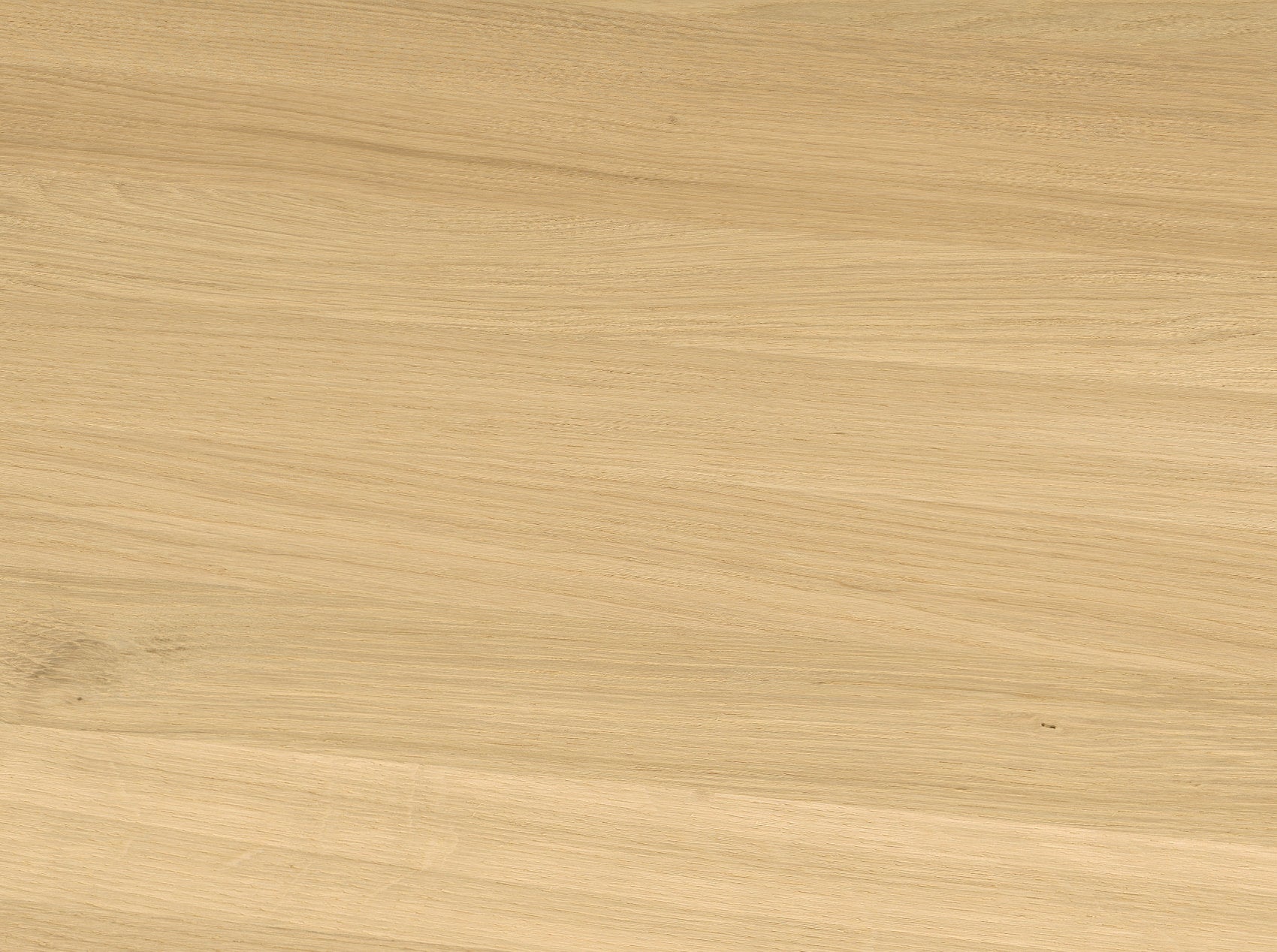
Glued-laminated panels are available in numerous wood species, dimensions, and thicknesses. Especially for tabletops, work surfaces, or larger pieces of furniture, a 40 mm thick panel is often the preferred choice. The substantial material edge underscores the solid character of the wood and can provide additional rigidity to a suitably designed construction.
However, not every project automatically requires a 40 mm thick glued-laminated panel. Whether this version makes sense depends on, among other things, the dimensions, the free span, the sub-construction, and the desired look. This guide shows when 40 mm is a suitable choice, when a thinner panel is sufficient, and what you should look out for regarding selection and processing.
What is a glued-laminated panel?
A glued-laminated panel consists of individual solid wood staves that are glued together on their sides. This creates a larger, cohesive wood surface that can be further processed for furniture and interior design.
Unlike particleboard or fiberboard, the panel's cross-section consists entirely of solid wood throughout. A glued-laminated panel is therefore a form of solid wood panel.
Glued-laminated panel or solid wood panel?
The terms are often used interchangeably or as synonyms in the trade. Technically, the solid wood panel is the umbrella term. Glued-laminated panels belong to this category because they consist of staves made of solid wood glued to one another.
To be distinguished from this is a wide board that has been cut entirely from a single piece of grown wood. For the selection of a suitable panel, the following points are therefore especially decisive:
- the wood species used,
- the thickness and dimensions of the panel,
- the arrangement of the staves,
- the visual grading,
- the intended area of application.
Continuous or finger-jointed staves?
In a glued-laminated panel with continuous staves, the individual wood strips run along the entire length of the panel without any end-to-end joints. This creates a longitudinally consistent wood grain pattern that is particularly effective on visible tabletops, work surfaces, and furniture parts.
With finger-jointed glued timber, on the other hand, shorter pieces of wood are also connected to one another in the longitudinal direction. The corresponding joints remain visible on the surface.


Continuous staves are not technically superior as a matter of principle. Their main advantage lies in the uniform appearance throughout the length. Which version is suitable for a project depends on the desired optics, the available dimensions, and the budget.
Why does the panel thickness matter?
The thickness influences both the construction and the visual effect of a piece of furniture. A 40 mm thick oak panel has a clearly visible material edge and appears more substantial than a panel with a thickness of 18, 20, or 26 mm.


Given the same wood species, comparable structure, and comparable quality, a thicker panel generally exhibits higher flexural rigidity. However, the material thickness alone does not determine which loads or free spans are possible.
The entire construction is decisive
Whether a panel is suitable for a specific project depends on several factors:
- length and width of the panel,
- distance and arrangement of the supports,
- type and position of the load,
- fiber direction of the wood,
- cutouts or drill holes,
- construction of the base frame,
- type of mounting.
A large tabletop with widely spaced table legs places different demands on the material than a worktop resting on several base cabinets. General statements regarding load-bearing capacity or permissible free span are therefore not meaningful without knowledge of the entire construction.
The visible edge as a design element
For many projects, the thickness is not chosen exclusively for constructional reasons. A 40 mm thick edge can visually support the proportions of a large dining table, a kitchen island, or a workbench.
Depending on the design, the edges can be finished straight, slightly chamfered, or rounded. With oak glued-laminated panels, the individual staves remain visible on the edge, making the material's structure easy to follow.
More thickness also means more weight
A 40 mm thick oak panel is significantly heavier than a thinner panel with the same length and width measurements. Transport, assembly, base frame, and hardware must therefore be matched to the actual panel format.
Larger panels should be moved by several people whenever possible and securely supported during processing.
20, 27, or 40 mm: Which thickness fits the project?
The appropriate panel thickness results from the interplay of design and construction. More material is not automatically better for every application.
| Panel thickness | Typical applications | What to look out for |
|---|---|---|
| approx. 18 to 20 mm | Smaller shelves, furniture fronts, cabinet parts, and compact furniture | Plan support distances and load accordingly |
| approx. 25 to 30 mm | Desks, sideboards, smaller tabletops, and furniture carcasses | Consider weight and desired edge effect |
| 40 mm | Larger tabletops, work surfaces, workbenches, and solid-designed furniture parts | Consider weight, sub-construction, and mounting |
For a small shelf or a short shelf board, a thinner panel can be completely sufficient. For a large table surface, however, the 40 mm version can be sensible from both a constructional and a design perspective.
Tip: Do not determine the panel thickness first. Start by determining the finished panel dimension, the position of the supports, and the desired edge effect. The appropriate thickness can be derived more reliably from these.
For which projects are 40 mm thick glued-laminated panels suitable?
Oak tabletops
An oak panel with 40 mm thickness is particularly suitable for table designs where a strong, solid edge is desired. With larger table formats, this can create balanced proportions, especially in combination with sturdy wooden or metal frames.
However, the panel thickness does not replace careful construction. The position and distance of the table legs influence the free span and thus also the potential for sagging.
Furthermore, the wood panel must be able to expand and contract slightly across the grain direction due to changing humidity. Suitable tabletop hardware, elongated holes, or comparable flexible mountings account for this natural behavior.
Worktops
40 mm thick glued-laminated panels are frequently chosen for work surfaces because the visible edge appears sturdy and fits well with larger kitchen furniture. Whether a specific panel can be used as a kitchen worktop depends on the construction, surface treatment, and information provided for the respective product.
Cutouts for sinks or hobs interrupt the panel cross-section and can weaken individual areas. They should be executed cleanly and treated carefully at the cut edges. Joints, wall connections, and areas around a sink should also be planned so that no moisture collects permanently.
Solid wood is not immune to water, heat, or standing moisture. Appropriate surface treatment and regular maintenance are therefore important components of usage.
Stair treads and stair renovation
Solid wood panels of appropriate thickness are also used for stairs. For this field of application, we offer separate oak stair tread panels with 40 mm thickness and continuous staves.
When selecting, construction, dimensions, mounting, and subsequent surface treatment must be considered in addition to the panel thickness.
Workbenches and robust work tables
For workbenches or larger work tables, a 40 mm thick panel can form a solid working surface. Here, too, the underlying construction remains decisive.
Vises, machinery, or other components subject to point loads should not be attached at arbitrary locations without verification. Depending on usage, additional frames, cross-braces, or locally reinforced areas may be necessary.
Sideboards, benches, and solid furniture parts
Not every piece of furniture requires a 40 mm panel for structural reasons. However, the material thickness can be consciously used as a design element.
For benches, sideboards, consoles, or open shelving, a thick top panel creates a clear contrast to more lightweight substructures. Before cutting, it should be determined which side of the panel will remain visible and how knots, color variations, or other natural wood features should be arranged in the furniture.
When are 40 mm not required?
A thinner glued-laminated panel can be the more sensible solution if the piece of furniture has small dimensions, the panel is supported across its entire surface, or low dead weight plays an important role.
Typical examples are:
- furniture fronts and cabinet doors,
- small shelves with short support distances,
- cabinet sides and carcass parts,
- decorative wall and furniture parts,
- lightweight and filigree-designed furniture,
- components that rest entirely on a sub-construction.
The right panel is not automatically the thickest, but the one whose structure and dimensions fit the respective project.
What you should look out for when choosing
Grading and appearance
The grading describes the visual characteristics of the wood surface. In A/B grade, the panel has a better-graded A-visible side and a more lively graded B-reverse side. A panel in B-grade shows an overall more rustic wood grain pattern, in which knots, knot holes, cracks, and color variations may appear. The details in the respective product description are decisive.
For projects with a more calm-graded visible surface, the glued-laminated oak panel in A/B grade, for example, is an option. During processing, the A-side should be planned as the later visible side.
Continuous or finger-jointed staves
If long, uninterrupted wood strips are to remain visible, continuous staves are a good choice. Finger-jointed panels show additional connections within the staves. The choice is primarily based on the desired appearance.
Surface condition
Raw, sanded glued-laminated panels can be further processed to suit the respective project. Before surface treatment, an additional fine sanding may be required depending on the desired result.
Oil, hard-wax oil, lacquer, and other coating systems make different demands on preparation, application, and drying. Which surfaces and edges must be treated in what way depends on the selected surface system and the subsequent construction. The processing instructions of the respective product must be observed.
Intended area of application
The oak glued-laminated panels described here are intended for non-load-bearing furniture and interior construction in dry indoor areas. They should not be used outdoors, in permanently damp areas, or as a load-bearing structural component without appropriate suitability.
Even within a building, care should be taken that the panel is not processed directly next to damp walls, on substrates that have not dried sufficiently, or in rooms with strongly fluctuating climatic conditions.
Panel size and cutting
Before ordering, not only the finished external dimensions should be calculated. Waste, saw cuts, edge processing, and potential cutouts must also be taken into account.
With a visible solid wood surface, it is also sensible to determine the later orientation of the staves and the position of prominent wood features before the first cut.
For furniture and interior design projects, you will find different grades with continuous staves in our selection of glued-laminated panels.
Processing glued-laminated panels correctly
Storing and preparing the panel
The panel should be stored in a dry, level, and sufficiently supported manner until processing. One-sided heating or moisture should be avoided.
Before processing, the material should be able to adapt to the climatic conditions of the later place of use. In doing so, air should be able to reach both sides of the panel.
Sawing, drilling, and edge processing
Clean cuts are achieved with sharp tools suitable for solid wood. A secure guide and a sufficiently large support surface facilitate the processing of the heavy panel.
Freshly sawn edges should at least be lightly broken. A small chamfer or rounding reduces sharp edges and can simultaneously serve as a design detail.
Fastening solid wood panels correctly
Solid wood changes its width depending on the wood moisture. The fastening must account for these potential dimensional changes.
A tabletop should therefore not be rigidly screwed to a base frame across its entire width. Suitable solutions can be, for example, tabletop fasteners, elongated holes, or other sliding connections.
Which fastening is suitable depends on the frame, the panel width, and the grain direction.
Treating the surface
Before applying a surface, the panel must be clean, dry, and evenly sanded. Dust and sanding residues must be carefully removed.
The suitable surface system depends on the later stress. The details regarding processing, application amount, drying, and maintenance of the respective product used are decisive.
Conclusion: When do 40 mm make sense?
A 40 mm thick glued-laminated panel is particularly suitable when a clearly visible solid wood edge is part of the design, larger panel formats are planned, or the construction can benefit from higher flexural rigidity.
Typical applications are large tabletops, work surfaces, workbenches, and consciously solidly designed furniture parts. The prerequisite remains a sub-construction that is tuned to the dimensions, weight, and usage.
For smaller furniture parts or fully supported surfaces, on the other hand, a thinner panel can be the more economical and easier-to-process solution. The decisive factor is not the greatest possible thickness, but a panel selection that sensibly connects construction, optics, and area of application.
Our 40 mm thick glued-laminated panels made of oak are available with continuous staves and in A/B and B-grade. This allows the panel to be selected to match a calmer or consciously lively furniture design.
Frequently asked questions about 40 mm thick glued-laminated panels
Answers regarding panel thickness, staves, areas of application, fastening, and processing.
Solid wood panel is the generic term. A glued laminated timber panel is a form of solid wood panel consisting of individual solid wood staves that are glued together at the edges.
Whether 40 mm is sensible depends on the size of the table top, the free span, the position of the table legs, the frame, and the desired edge aesthetic. For large table formats, this thickness can be appropriate both structurally and visually. However, it does not replace a sufficiently stable base frame.
Continuous staves run the entire length of the panel without any end-grain joints. This creates a continuous longitudinal wood grain. With finger-jointed panels, shorter pieces of wood are connected to one another lengthwise.
Depending on the product, construction, and surface treatment, a 40 mm thick glued laminated panel can be used as a work surface. Cutouts, exposed edges, moisture protection, and the substructure must be planned carefully.
The attachment method should allow for potential dimensional changes across the grain. Suitable options include table top fasteners, slotted holes, or other sliding joints. Rigid bolting across the entire width of the panel should be avoided.
The glued laminated panels described here are intended for dry indoor use and are not automatically suitable for outdoor use. The decisive factors are the specifications for the respective product, the construction, and protection against moisture.
