


Cart
0

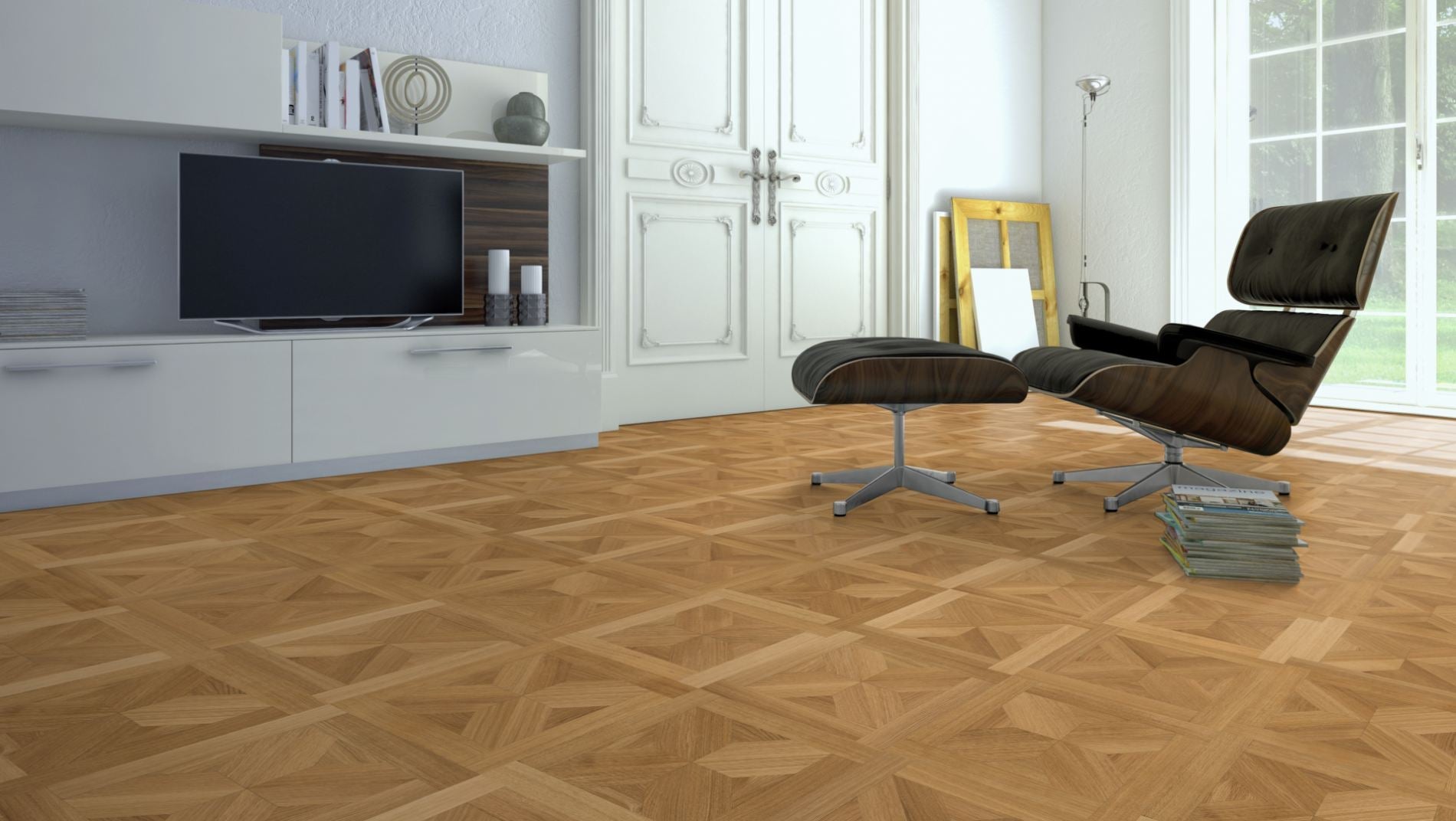
Panel parquet belongs to the traditional types of parquet where the design is already inherent in the individual panel. Unlike classic floorboards or separately laid parquet strips, such a panel floor consists of prefabricated square elements. Each panel bears a clearly defined pattern that repeats across the entire floor surface during installation.
The range extends from clear geometric compositions to star and ornamental patterns. Panel parquet is known, among other things, from historic villas, palaces, and prestigious buildings. Precisely cut pieces of wood, alternating grain directions, and the regular repetition of the panels determine its special visual effect.
The Vienna panel parquet made of solid European oak takes up this artisanal tradition with a striking star motif. The 10 mm thick panels have a format of 478 × 478 mm. Behind every finished element lie several coordinated work steps – from cutting the triangles to gluing them in the clamping frame.
Other panel parquet patterns, such as Berlin, follow a different geometric arrangement. However, this article focuses exclusively on the production of the Vienna pattern.
Many individual parts make up the Vienna panel parquet pattern
A finished panel of the Vienna pattern consists of a total of 16 solid oak pieces. The inner field is composed of four triangles and eight trapezoidal shaped parts. In addition, there are four surrounding border strips that frame the pattern and give the panel its square basic shape.
Each workpiece has a precisely defined shape. Only through the correct arrangement of the triangles, trapezoids, and border strips does the complete star motif emerge. Even small deviations during cutting or assembly could later affect the joints and the geometry of the panel.

Precise cutting of the triangles
Production begins with solid parquet strips made of European oak. Among other things, the triangular shaped parts for the inner motif are cut from them. The sloping cut edges must be matched to the adjacent trapezoids.
This accuracy is particularly important for the Vienna panel parquet: several sloping edges meet directly within the star motif. Careful cutting therefore forms the basis for the subsequent arrangement of the individual oak pieces.

The finished triangles are prepared
After cutting, the triangles are collected, checked, and set aside for further work steps. The multitude of uniform workpieces shows how many individual cuts are required just for the production of a small series of parquet panels.
The individual triangles only hint at the later star pattern. Only through the interaction with the trapezoidal shaped parts does it become visible how the inner field of the panel develops from the initially separately manufactured elements.

The star motif emerges step by step
In the next work step, the four triangles and the eight trapezoidal shaped pieces are arranged in the intended order. The sloping edges interlock and gradually form the star-like geometry of the Vienna pattern.
In addition to the shapes, the natural grain of the oak also influences the appearance. The individual workpieces have different fiber directions. Depending on the incidence of light, this can create alternating light-dark effects that further emphasize the geometric motif.
Neither different types of wood nor colored inlays are required for this visual depth. It arises from the interplay of cutting, arrangement, and natural wood pattern.
The border strips form the outer frame
Once the inner motif is fully arranged, the four border strips are added. They enclose the star pattern and complete the panel on the outside.
Characteristic of the Vienna pattern is the design of the corners. The border strips are not mitered together. Instead, one border strip meets the next at a right angle. This offset construction creates the striking frame of the panel element.
Gluing in the clamping frame
As soon as all 16 oak pieces are in their intended position, the panel is glued. For this, the assembled element is placed in a clamping frame.
The frame holds the triangles, trapezoids, and border strips in their arrangement during the setting process. The pressure applied supports an even alignment of the workpieces and a joint pattern that is as tight as possible. It is only through this work step that the previously individual parts are permanently joined into a complete parquet panel.
After setting, the panel can be removed from the frame and prepared for further production or processing steps.

The effect is created through repetition
A single panel already shows the complete star motif. However, how the panel floor affects the room later only becomes clear with several elements lying next to each other.
When the square panels are placed together, the motif repeats at regular intervals. The frames of the individual panels structure the area while the stars relate to one another. In this way, a coherent geometric floor image is created from many identical elements.
Up close, the individual wood pieces, joints, and grain patterns take center stage. As the viewing distance increases, however, the overall pattern becomes clearer. This interplay between artisanal detail and large-scale design characterizes the Vienna panel parquet.

Vienna panel parquet: from individual oak pieces to the star pattern
The production of the Vienna panel parquet shows how closely precise cutting, careful arrangement, and artisanal processing are linked. Step by step, a square parquet panel with a recurring star motif is created from triangles, trapezoids, and border strips.
The natural grain of the solid European oak remains an essential part of the design. Each panel follows the same geometric order but may differ slightly from the adjacent elements due to the color, structure, and fiber progression of the wood.
Our Vienna panel parquet is also available in a 15 mm version. Further patterns and versions can be found in our panel floor collection.
